By Saturday morning we were feeling rested enough to go out exploring again. I've already done quite a bit of tourist-ing in Santiago, so I gave Mom my guide book and let her pick our destination. She decided on La Chascona, one of three houses built by Chilean poet Pablo Neruda. It was about a 45 minute walk from my apartment, but we didn't have anything else planned for the day so we could take it slow. There are a lot of interesting sites on the way, so we started out on our adventure, planning to see as much as we could on the way.

We headed out towards Vicuña Mackenna, one of the main streets in downtown Santiago. It's only a few blocks from my house, but usually my only interaction with it is to cross it each morning getting to the metro. This time, we turned onto it and began to follow it into the heart of Santiago. We stopped by the hostel I'd stayed in for the first couple weeks in Chile, and it was fun to remember the memories and friends I'd made there. A few streets past the hostel, we saw a little street with quite a different personality than most others here in the city. This one was fairly narrow, and had tall, colorful, row-style houses lining it. Right in the middle of all the houses was a corridor covered in mosaics. We decided to take a detour down that street to admire the houses, and were pleasantly surprised to see that spring had brought fresh flowers to the front yards. The colors of the flowers blended perfectly with the hues of the houses, and the smell was wonderful! I stopped to smell the flowers while Mom snapped a few pictures.

Our next stop was Parque Bustamante, just on the other side of the neighborhood. I've been through the park before, but usually on my way to other places while in a hurry, so I've never really stopped to take a good look. Some of the other native English teachers from my school go there to work out after class, but so far my schedule hasn't meshed up enough with theirs to allow me to go. Plus, I'm not too into working out anyway. But I suppose if I must, Parque Bustamante would be a great place to do it. There are a bunch of exercise machines, just like you would see at the gym. Except these are much better because they are outside, and they're free! Obviously, we had to try some out. I was surprised at how well they worked, considering how many people have probably used them through the years. There were quite a few other people working out, too, including a toddler who was doing her utmost to use one as a swing.

And, just in case you don't like working out alone, there are free, live exercise classes! It was a nice day, so we stopped to watch for a while. Most of the participants were having a great time and getting some exercise in the meantime. There was, however, one woman who was taking her exercise very seriously. Even when everyone else stopped for water breaks, she kept shakin' it. Not only was she the most invested in the exercise program, she was probably the oldest by about 20 years. Most of the other participants seemed to be middle-aged or younger, but this woman had to be about 60. It's great to see people stay active! Especially when they are as entertaining as she was. Once we'd had our fill of watching other people exercise, we continued on our way. We passed by a nice cafe in the middle of the park that I'd never noticed before. It was two stories with a big pond out front. It was packed full inside and out of people enjoying the nice weather on the weekend morning. We'd had enough coffee at home before setting out, so we skipped the cafe and kept walking. We reached the Mapocho river--once the pride of Santiago, but now a small, polluted stream. And it has actually improved in recent years, apparently! It's sights like that that makes me ashamed. Although I guess I haven't really done anything to improve it, either, so I can't really complain, can I?
Across the bridge on the other side of the Mapocho, we came across another artisan fair. We stopped in, just to see if they had anything more to offer than at the fair nearer my house. We found a really awesome rainbow knitted sweater, but did our best efforts and self-control and avoided buying it. It'd definitely be a way to get noticed, though (not that I really need to make an effort for that here in Chile)! We stopped by another booth where a woman was selling jewelry made from recycled silverware. She had earrings, necklaces, bracelets, and even a tree for holding the jewelry made from forks! It was really neat, and we were very tempted, but it could only hold two necklaces or two pairs of earrings. If you've ever glimpsed my earring collection, you'd know just how inadequate that would be for me. Instead, we bought some necklaces to give as gifts.
 |
| www.nadir.org |
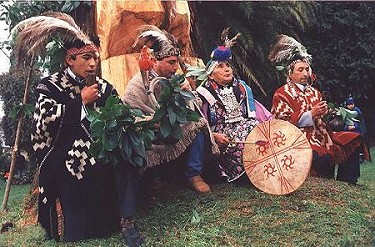
Next, we stopped by a booth run by a young man, probably about my age. He was also selling jewelry made from alpaca (no, not the animal. It's a metal similar to silver). That isn't too exciting in itself; lots of people sell metal jewelry. What was so interesting about his was that it was all hand carved. Yes, he carved designs into each piece with a very tiny hand saw. He showed us one he was working on--a hair pin with the design of a kultrun on it. He told us that he is very proud of his Mapuche (indigenous tribe from the south of Chile) heritage, and that the kultrun was one of the most important symbols of his culture. He then even took the time to explain the symbolism for us, in English! Kultrun is a Mapuche word that means "object of sound" or, a drum. But these aren't just any drums--they are ceremonial drums onto which the whole story of relationship between heaven and earth is depicted.
 |
| pueblosoriginarios.com |
The artisan explained that, first of all, the symbols on the kultrun explain the delicate balance of earth and heaven. The circular pattern is divided into four parts by lines representing the four cardinal directions--north, east, south, and west. Between the four points, two different patterns can be depicted. In the example I found online, there are four representations of the wind moving always through time. The artisan instead had two suns and two moons, also representing the passing of time. From each cardinal direction sprout two more branches, one for each month in the year. Long before being introduced to Western culture, the Mapuche counted 12 months in a year. The space between each grouping of three months represents a different season. Between east and north lies winter, the rainy season. For the Mapuche, this was the season of fertility, when the earth received nutrients and water. Next, between north and west comes spring. This meant it was time for the people to move from their winter habitation to their summer residence and begin a long period of work in preparation for the fertile summer that would hopefully result from a rejuvenating winter. Between west and south is summer--harvest time. This is a time of great abundance and celebration. Finally, between south and east is autumn. This is when families began to prepare once again for the difficult winter, stockpiling their resources from the summer harvest. It's a time to share what you have with others, both in resources and knowledge. Once the four seasons have been completed, it's time to start again. The circle continues with every new generation, never ending. There were a lot more symbols within the design, as well, but I don't remember enough to give an accurate account (and it is surprisingly difficult to find conclusive information on the internet!).
Not only was it great to hear the history of the Mapuche from a member of the tribe, it was wonderful to hear the pride in his voice as he told it. Like most indigenous people, the Mapuche have suffered a lot through the years and have lost much of their cultural heritage. It has only been recently, in the past generation or so, that the Mapuche are reclaiming their heritage and showing their pride. The last time I was in Chile, I even had the opportunity to visit the only school in the country taught exclusively in Mapudungun, the language of the Mapuche. In fact, the first class to go all the way from kindergarten to final year should be graduating about now! We didn't buy anything from that artisan because his stuff was a little out of our price range (definitely worth the price, though). We thanked him for sharing his heritage with us, and then decided we'd better move on from the fair if we wanted our money to last the rest of the week!
 |
| Pastel de Choclo |
Although a straight walk should have taken us to La Chascona in about 45 minutes, our frequent stops drew out the time much longer. We were starting to get tired and hungry, so we stopped over in Barrio Bellavista for some lunch before going to the museum. Bellavista is a trendy neighborhood that is popular with young people because it is packed wall-to-wall with restaurants, bars, and clubs. Luckily, it was just past noon so the hard-core partying hadn't started quite yet (although we saw a few people who were definitely trying). Mom still hadn't gotten the chance to try any Chilean food on this visit, so we headed over to
Galindo, one of the most well-know Chilean restaurants in Santiago. It was a nice day, so we sat outside on the patio. I tried to order humitas (they're like large tamales), but was told that those are only summer food. Instead, I went for the ever-popular porotos (bean stew). Mom opted for the world-famous pastel de choclo (corn pie). The restaurant is popular among tourists, so we got to hear all sorts of languages and accents as we ate. As tired as we were, we enjoyed our food quietly, trying to see if we could guess all the different accents around us.
 |
| Porotos |
Once again, the portions were much bigger than we'd anticipated. Luckily for Mom, she hadn't eaten breakfast that day and managed to make a heroic effort on her corn pie. I, on the other hand, had to ask for a to-go box for the rest of my meal. When we finished, Mom went to the corner of the street to have a cigarette while I waited for the bill. During our meal the restaurant had gotten pretty busy, so I had a bit of a wait before I could leave the table. I was surprised that Mom actually didn't get bored and come back, but when I finally went over to meet her, I saw why. She had run into (once again) the woman from my apartment! They told me it must be fate, because this was now the fifth time in three days that they'd come across one another. I guess it's not that strange in the apartment (although there are about 250 units with an average of two people in each), but it was really amazing to run into her in the middle of the big city! She had actually just come from La Chascona and was heading out to explore the rest of the city. We chatted for a few minutes and then went our separate ways.

 |
| worldnomads.com |
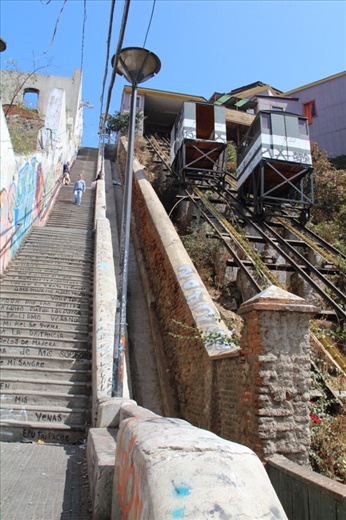
We thought our next stop would definitely be La Chascona (we were only three blocks away!), but we managed to get sidetracked one more time. We walked by a restaurant with a beautiful fence that looked like vines with flowers on it. Of course we needed to take some pictures! Next to the restaurant was a new store that I'd never seen before (I've walked past that area many times during weekend strolls). We weren't in a hurry, so we went in to check it out. The owner was very friendly and explained that everything for sale was hand-made by different people. The store was created by a group of friends who are all artisans and wanted a place to display and sell their artwork. Mom found a neat condiment holder made from a seashell, and we were about to leave when she spotted one more thing. It was a screen printing on canvas of some of the most famous stairs in Valparaiso. She really liked it, but didn't want to get it because she hasn't been there. She showed it to me anyway, just so I could admire it too. I looked at it and realized that those stairs were particularly familiar to me--it was just a few feet from the top that Scott had proposed to me! When I told Mom that, she got very excited (and tried to tell everyone in the store about the story). She decided to buy it for us as a wedding gift. But it's a surprise, so don't tell me!
 |
| www.tripadvisor.com |
After dragging ourselves out of the store (there were so many unique things!), we finally made our way up the last few feet to the entrance of Pablo Neruda's house,
La Chascona. We were in luck, too, because the next English-language tour would be leaving in only half an hour! We checked out the gift shop while we waited for the tour. I'd done the tour before, when Scott came to visit, but the house really is marvelous so I was excited to see it again. I was also glad to see that the tour guide that would be leading our tour this time was a different one than the first time. It's always interesting to see the differences between different guides (and you find out which part of the stories are made-up, too, because each guide adds a different twist)! When I went with Scott, we had a female guide, so a lot of the tour consisted of torrid love stories. This time, our guide was male. There was hardly any mention of romance (except what was required to explain the marriage of Neruda to the wife after whom the house is name), but there was a lot of emphasis on Neruda as a politician. Though most of the information was the same, it was fun to be able to experience the varied presentations of it!
 |
Pablo Neruda and Matilde Urrutia
elmercuriodigital.net |
Unfortunately, you're not allowed to take pictures inside the house, so we don't have any of our own. But there are plenty around the internet if you take the time to search! Not only is La Chascona interesting for its architecture, but also for all the various memorabilia collected by Neruda throughout his travels as an ambassador for Chile. There are also some pretty good stories attached to the house. Probably the most well-known story is how the house got its name in the first place. It is named after Neruda's third wife, Matilde Urrutia. She was easily recognized by her wild red hair, only one of many of her features that Neruda had fallen in love with. Because of this, he gave her the nickname "la Chascona," which means "disheveled hair" in Quechua, the language of the indigenous people of northern Chile. It was only fitting that the house built for her should have the same name.
 |
| sopame.blogspot.com |
Neruda and Urrutia's relationship began in secret while Neruda was still married to his previous wife, Delia del Carnil. Urrutia was an artist herself and was well-known in Chile as a writer and singer. She and Neruda met for the first time through mutual artist friends in Santiago in 1946. They quickly became friends, but didn't see much of each other again until 1949 when they were both in Mexico. Neruda had been sent there in exile for his participation in the Communist Party of Chile. Here, they truly fell in love and began their secret affair. They maintained their relationship in secret for many years, telling only their closest friends the truth. One of these friends was Mexican muralist Diego Rivera, who commemorated the relationship with a painting of Matilde. In his depiction, she has two heads--one for each part she had to play in Neruda's life. One for the face she put out when she pretended to be just friends, and another she could wear when they were together as lovers. And of course she could not be alone in a painting about lovers--take a close look in her hair on the far right; you can see the outline of Neruda's face hidden within her curls.
 |
| plataformaurbana.cl |
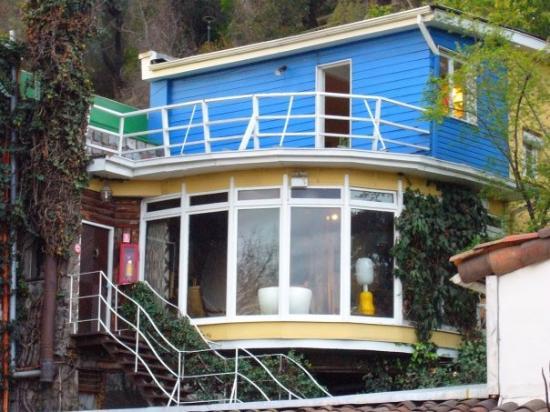
By 1955, the lovers could not longer keep their relationship a secret and Neruda finally separated from his previous wife. He had actually begun to build La Chascona for Urrutia before the separation, in 1953. He hired another good friend to design it for him--Catalan architect German Rodriguez Arias. The architect commented that he was apprehensive about designing a house on such a steep hill, but did his best to design around it. It was initially designed to face towards the south to give a view of the city, but Neruda preferred the view of the mountains and had the house completely re-oriented. He also continually brought cypress and other wood species up from the south from which to construct the house. He also broke convention by asking Arias to build an entire room around his favorite couch and painting. In fact, the painting is permanently installed as part of the wall of the living room. By the time it was finished, the house was completely different than envisioned by Arias, but turned out to be exactly what Neruda wanted.
 |
| crystalacarte.com |
The house is actually composed of three separate buildings--the guest house, the main living area, and the office. The entire house is completely filled with mementos that Neruda had collected during his travels around the world. Unfortunately, most of the original pieces housed in La Chascona were lost when soldiers destroyed the house and its contents after the military coup of 1973. The objects now inside the house were brought from Neruda's other houses and donated by the French government for which he was ambassador for many years. There were so many interesting details that I can't begin to describe them all here, but I'll note the most interesting ones. In the dining room of the guest house (which was very narrow with a low ceiling, modeled after a ship), each table setting had a different colored glass. This was because Neruda believed that color of the vessel influenced the taste of the liquid, so always had many options available for each of his moods. According to our guide, Neruda's favorite "flavor" was green. Another interesting detail of the guest house is the pantry. One side is just what you would expect from a pantry--full of shelves and everyday kitchen supplies. But the other door opens up to a secret stairwell that leads upstairs to a breakfast nook and guest bedroom! I am most definitely getting one of those for my house!
 |
| taraandkarinagoout.com |
We continued on our tour, overwhelmed by the electic mix of objects throughout the house and garden. In just about every room, and hung on some of the trees, were giant sketches of eyes. We asked the guide why, and he told us that they were Neruda's version of security cameras. No matter where you are in the house, you're always being watched. So don't misbehave! That must explain why there seemed to be extra eyes hung on the tree next to the outdoor bar--extra temptation there! Mom decided that the bar was the part of the house that she wouldn't mind adding to hers. It even came complete with a giant pair of shoes, something Neruda had apparently picked up from a shoe shop in the south of Chile. During that time period, there was an extremely high illiteracy rate in the country, so shops had to display the goods they were selling. And if you want to sell shoes, how better to demonstrate your wares than to hang up a giant pair of them!?
 |
| artofschmidt.com |
After our tour, we were starting to get tired out, but decided to try to walk back home anyway. It was a nice day, so we thought we might stop for a drink on the way back. We walked through Bellavista, this time avoiding all the artisan shops. We didn't completely manage to avoid all temptation, though, as we came across a street vendor selling trees and animals made from bent wire. He ended up having a conversation with us in English, and even offered to drop the price of his tree down from 10 mil to 5 mil,
and throw in two free flowers just for fun! We could hardly say no to that offer! He also tried to sell us a sculpted tarantula, but Mom told him she would probably get in trouble for bringing that on the plane. He told her not to worry, because he had, in fact, already traveled on a plane with it! He did get momentarily detained when the customs officers insisted on searching his bag for live animals and he threatened that his giant pet spider would bite them. Apparently, it took a while before anyone was brave enough to actually open the bag. But he guaranteed that it would be allowed past security. We politely declined and went back on our way with our new metallic flora.

On the way back we walked through Barrio Lastarria, a bohemian neighborhood that is mostly populated by actors and musicians. On the weekends there is a street fair with vendors selling used books and antiques. Of course we had to stop by for a look. Unfortunately, all the really cool stuff was too big to fit in a suitcase, so we had to pass it up. That doesn't mean we didn't enjoy looking, though! Once we'd had our fill there, we walked a couple blocks more to where all the restaurants were located in the neighborhood. We'd made it about halfway home by this time, so we figured we deserved a break. We chose a restaurant that was built into the ruins of an old estate that had been build to resemble a castle. We were mostly just hot and tired, so Mom ordered a glass of red wine and I ordered some ice cream. The waitress listed off some strange flavors that I hadn't heard before, and she couldn't really describe them when I asked her to. So, I told her just to surprise me. I never really was sure what the flavors were, but they were pretty delicious! And the best part was the fact that it was served in a martini glass with a fresh flower decorating the top!
By the time we finished our wine and ice cream (great combination, by the way), it was starting to get dark. We thought about taking a cab the rest of the way home, but decided to brave the walk. The last few blocks were a big tough, but we managed to get there pretty much in one piece. We took a quick stop at the grocery store across the street to get some more wine for dinner, and headed up stairs. We ate some leftover curry, watched some bad American tv, and went to bed. For a day that started out on a whim, it turned out fairly awesome!




No comments:
Post a Comment