Saturday, September 22, 2012

La Chascona

By Saturday morning we were feeling rested enough to go out exploring again.  I've already done quite a bit of tourist-ing in Santiago, so I gave Mom my guide book and let her pick our destination.  She decided on La Chascona, one of three houses built by Chilean poet Pablo Neruda.  It was about a 45 minute walk from my apartment, but we didn't have anything else planned for the day so we could take it slow.  There are a lot of interesting sites on the way, so we started out on our adventure, planning to see as much as we could on the way.

We headed out towards Vicuña Mackenna, one of the main streets in downtown Santiago.  It's only a few blocks from my house, but usually my only interaction with it is to cross it each morning getting to the metro.  This time, we turned onto it and began to follow it into the heart of Santiago.   We stopped by the hostel I'd stayed in for the first couple weeks in Chile, and it was fun to remember the memories and friends I'd made there.  A few streets past the hostel, we saw a little street with quite a different personality than most others here in the city.  This one was fairly narrow, and had tall, colorful, row-style houses lining it.  Right in the middle of all the houses was a corridor covered in mosaics.  We decided to take a detour down that street to admire the houses, and were pleasantly surprised to see that spring had brought fresh flowers to the front yards.  The colors of the flowers blended perfectly with the hues of the houses, and the smell was wonderful!  I stopped to smell the flowers while Mom snapped a few pictures.

Our next stop was Parque Bustamante, just on the other side of the neighborhood.  I've been through the park before, but usually on my way to other places while in a hurry, so I've never really stopped to take a good look.  Some of the other native English teachers from my school go there to work out after class, but so far my schedule hasn't meshed up enough with theirs to allow me to go.  Plus, I'm not too into working out anyway.  But I suppose if I must, Parque Bustamante would be a great place to do it. There are a bunch of exercise machines, just like you would see at the gym.  Except these are much better because they are outside, and they're free!  Obviously, we had to try some out.  I was surprised at how well they worked, considering how many people have probably used them through the years.  There were quite a few other people working out, too, including a toddler who was doing her utmost to use one as a swing.

And, just in case you don't like working out alone, there are free, live exercise classes!  It was a nice day, so we stopped to watch for a while.  Most of the participants were having a great time and getting some exercise in the meantime.  There was, however, one woman who was taking her exercise very seriously.  Even when everyone else stopped for water breaks, she kept shakin' it.  Not only was she the most invested in the exercise program, she was probably the oldest by about 20 years.  Most of the other participants seemed to be middle-aged or younger, but this woman had to be about 60.  It's great to see people stay active!  Especially when they are as entertaining as she was.  Once we'd had our fill of watching other people exercise, we continued on our way.  We passed by a nice cafe in the middle of the park that I'd never noticed before.  It was two stories with a big pond out front.  It was packed full inside and out of people enjoying the nice weather on the weekend morning.  We'd had enough coffee at home before setting out, so we skipped the cafe and kept walking.  We reached the Mapocho river--once the pride of Santiago, but now a small, polluted stream.  And it has actually improved in recent years, apparently!  It's sights like that that makes me ashamed.  Although I guess I haven't really done anything to improve it, either, so I can't really complain, can I?

Across the bridge on the other side of the Mapocho, we came across another artisan fair.  We stopped in, just to see if they had anything more to offer than at the fair nearer my house.  We found a really awesome rainbow knitted sweater, but did our best efforts and self-control and avoided buying it.  It'd definitely be a way to get noticed, though (not that I really need to make an effort for that here in Chile)!  We stopped by another booth where a woman was selling jewelry made from recycled silverware.  She had earrings, necklaces, bracelets, and even a tree for holding the jewelry made from forks!  It was really neat, and we were very tempted, but it could only hold two necklaces or two pairs of earrings.  If you've ever glimpsed my earring collection, you'd know just how inadequate that would be for me.  Instead, we bought some necklaces to give as gifts.

www.nadir.org
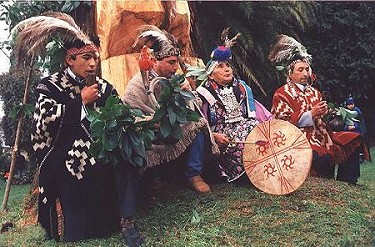
Next, we stopped by a booth run by a young man, probably about my age.  He was also selling jewelry made from alpaca (no, not the animal.  It's a metal similar to silver).  That isn't too exciting in itself; lots of people sell metal jewelry.  What was so interesting about his was that it was all hand carved.  Yes, he carved designs into each piece with a very tiny hand saw.  He showed us one he was working on--a hair pin with the design of a kultrun on it.  He told us that he is very proud of his Mapuche (indigenous tribe from the south of Chile) heritage, and that the kultrun was one of the most important symbols of his culture.  He then even took the time to explain the symbolism for us, in English!  Kultrun is a Mapuche word that means "object of sound" or, a drum.  But these aren't just any drums--they are ceremonial drums onto which the whole story of relationship between heaven and earth is depicted.

pueblosoriginarios.com
The artisan explained that, first of all, the symbols on the kultrun explain the delicate balance of earth and heaven.  The circular pattern is divided into four parts by lines representing the four cardinal directions--north, east, south, and west.  Between the four points, two different patterns can be depicted.  In the example I found online, there are four representations of the wind moving always through time.  The artisan instead had two suns and two moons, also representing the passing of time.  From each cardinal direction sprout two more branches, one for each month in the year.  Long before being introduced to Western culture, the Mapuche counted 12 months in a year.  The space between each grouping of three months represents a different season.  Between east and north lies winter, the rainy season.  For the Mapuche, this was the season of fertility, when the earth received nutrients and water.  Next, between north and west comes spring.  This meant it was time for the people to move from their winter habitation to their summer residence and begin a long period of work in preparation for the fertile summer that would hopefully result from a rejuvenating winter.  Between west and south is summer--harvest time.  This is a time of great abundance and celebration.  Finally, between south and east is autumn.  This is when families began to prepare once again for the difficult winter, stockpiling their resources from the summer harvest.  It's a time to share what you have with others, both in resources and knowledge.  Once the four seasons have been completed, it's time to start again.  The circle continues with every new generation, never ending.  There were a lot more symbols within the design, as well, but I don't remember enough to give an accurate account (and it is surprisingly difficult to find conclusive information on the internet!).  

Not only was it great to hear the history of the Mapuche from a member of the tribe, it was wonderful to hear the pride in his voice as he told it.  Like most indigenous people, the Mapuche have suffered a lot through the years and have lost much of their cultural heritage.  It has only been recently, in the past generation or so, that the Mapuche are reclaiming their heritage and showing their pride.  The last time I was in Chile, I even had the opportunity to visit the only school in the country taught exclusively in Mapudungun, the language of the Mapuche.  In fact, the first class to go all the way from kindergarten to final year should be graduating about now!  We didn't buy anything from that artisan because his stuff was a little out of our price range (definitely worth the price, though).  We thanked him for sharing his heritage with us, and then decided we'd better move on from the fair if we wanted our money to last the rest of the week!

Pastel de Choclo
Although a straight walk should have taken us to La Chascona in about 45 minutes, our frequent stops drew out the time much longer.  We were starting to get tired and hungry, so we stopped over in Barrio Bellavista for some lunch before going to the museum.  Bellavista is a trendy neighborhood that is popular with young people because it is packed wall-to-wall with restaurants, bars, and clubs.  Luckily, it was just past noon so the hard-core partying hadn't started quite yet (although we saw a few people who were definitely trying).  Mom still hadn't gotten the chance to try any Chilean food on this visit, so we headed over to Galindo, one of the most well-know Chilean restaurants in Santiago.  It was a nice day, so we sat outside on the patio.  I tried to order humitas (they're like large tamales), but was told that those are only summer food.  Instead, I went for the ever-popular porotos (bean stew).  Mom opted for the world-famous pastel de choclo (corn pie).  The restaurant is popular among tourists, so we got to hear all sorts of languages and accents as we ate.  As tired as we were, we enjoyed our food quietly, trying to see if we could guess all the different accents around us.

Porotos
Once again, the portions were much bigger than we'd anticipated.  Luckily for Mom, she hadn't eaten breakfast that day and managed to make a heroic effort on her corn pie.  I, on the other hand, had to ask for a to-go box for the rest of my meal.  When we finished, Mom went to the corner of the street to have a cigarette while I waited for the bill.  During our meal the restaurant had gotten pretty busy, so I had a bit of a wait before I could leave the table.  I was surprised that Mom actually didn't get bored and come back, but when I finally went over to meet her, I saw why.  She had run into (once again) the woman from my apartment!  They told me it must be fate, because this was now the fifth time in three days that they'd come across one another.  I guess it's not that strange in the apartment (although there are about 250 units with an average of two people in each), but it was really amazing to run into her in the middle of the big city!  She had actually just come from La Chascona and was heading out to explore the rest of the city.  We chatted for a few minutes and then went our separate ways.

worldnomads.com
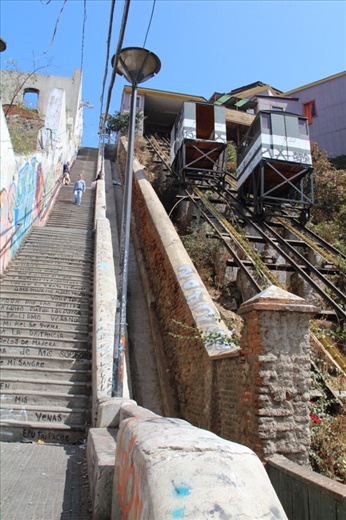
We thought our next stop would definitely be La Chascona (we were only three blocks away!), but we managed to get sidetracked one more time.  We walked by a restaurant with a beautiful fence that looked like vines with flowers on it.  Of course we needed to take some pictures!  Next to the restaurant was a new store that I'd never seen before (I've walked past that area many times during weekend strolls).  We weren't in a hurry, so we went in to check it out.  The owner was very friendly and explained that everything for sale was hand-made by different people.  The store was created by a group of friends who are all artisans and wanted a place to display and sell their artwork.  Mom found a neat condiment holder made from a seashell, and we were about to leave when she spotted one more thing.  It was a screen printing on canvas of some of the most famous stairs in Valparaiso.  She really liked it, but didn't want to get it because she hasn't been there.  She showed it to me anyway, just so I could admire it too.  I looked at it and realized that those stairs were particularly familiar to me--it was just a few feet from the top that Scott had proposed to me!  When I told Mom that, she got very excited (and tried to tell everyone in the store about the story).  She decided to buy it for us as a wedding gift.  But it's a surprise, so don't tell me!

www.tripadvisor.com
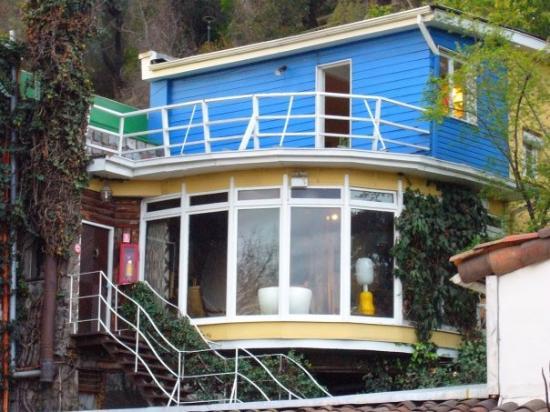
After dragging ourselves out of the store (there were so many unique things!), we finally made our way up the last few feet to the entrance of Pablo Neruda's house, La Chascona.  We were in luck, too, because the next English-language tour would be leaving in only half an hour!  We checked out the gift shop while we waited for the tour.  I'd done the tour before, when Scott came to visit, but the house really is marvelous so I was excited to see it again.  I was also glad to see that the tour guide that would be leading our tour this time was a different one than the first time.  It's always interesting to see the differences between different guides (and you find out which part of the stories are made-up, too, because each guide adds a different twist)!  When I went with Scott, we had a female guide, so a lot of the tour consisted of torrid love stories.  This time, our guide was male.  There was hardly any mention of romance (except what was required to explain the marriage of Neruda to the wife after whom the house is name), but there was a lot of emphasis on Neruda as a politician.  Though most of the information was the same, it was fun to be able to experience the varied presentations of it!

Pablo Neruda and Matilde Urrutia
elmercuriodigital.net
Unfortunately, you're not allowed to take pictures inside the house, so we don't have any of our own.  But there are plenty around the internet if you take the time to search!  Not only is La Chascona interesting for its architecture, but also for all the various memorabilia collected by Neruda throughout his travels as an ambassador for Chile.  There are also some pretty good stories attached to the house.  Probably the most well-known story is how the house got its name in the first place.  It is named after Neruda's third wife, Matilde Urrutia.  She was easily recognized by her wild red hair, only one of many of her features that Neruda had fallen in love with.  Because of this, he gave her the nickname "la Chascona," which means "disheveled hair" in Quechua, the language of the indigenous people of northern Chile.  It was only fitting that the house built for her should have the same name.

sopame.blogspot.com
Neruda and Urrutia's relationship began in secret while Neruda was still married to his previous wife, Delia del Carnil.  Urrutia was an artist herself and was well-known in Chile as a writer and singer.  She and Neruda met for the first time through mutual artist friends in Santiago in 1946.  They quickly became friends, but didn't see much of each other again until 1949 when they were both in Mexico.  Neruda had been sent there in exile for his participation in the Communist Party of Chile.  Here, they truly fell in love and began their secret affair.  They maintained their relationship in secret for many years, telling only their closest friends the truth.  One of these friends was Mexican muralist Diego Rivera, who commemorated the relationship with a painting of Matilde.  In his depiction, she has two heads--one for each part she had to play in Neruda's life.  One for the face she put out when she pretended to be just friends, and another she could wear when they were together as lovers.  And of course she could not be alone in a painting about lovers--take a close look in her hair on the far right; you can see the outline of Neruda's face hidden within her curls.

plataformaurbana.cl
By 1955, the lovers could not longer keep their relationship a secret and Neruda finally separated from his previous wife.  He had actually begun to build La Chascona for Urrutia before the separation, in 1953.  He hired another good friend to design it for him--Catalan architect German Rodriguez Arias.  The architect commented that he was apprehensive about designing a house on such a steep hill, but did his best to design around it.  It was initially designed to face towards the south to give a view of the city, but Neruda preferred the view of the mountains and had the house completely re-oriented.  He also continually brought cypress and other wood species up from the south from which to construct the house.  He also broke convention by asking Arias to build an entire room around his favorite couch and painting.  In fact, the painting is permanently installed as part of the wall of the living room.  By the time it was finished, the house was completely different than envisioned by Arias, but turned out to be exactly what Neruda wanted.

crystalacarte.com
The house is actually composed of three separate buildings--the guest house, the main living area, and the office.  The entire house is completely filled with mementos that Neruda had collected during his travels around the world.  Unfortunately, most of the original pieces housed in La Chascona were lost when soldiers destroyed the house and its contents after the military coup of 1973.  The objects now inside the house were brought from Neruda's other houses and donated by the French government for which he was ambassador for many years.  There were so many interesting details that I can't begin to describe them all here, but I'll note the most interesting ones.  In the dining room of the guest house (which was very narrow with a low ceiling, modeled after a ship), each table setting had a different colored glass.  This was because Neruda believed that color of the vessel influenced the taste of the liquid, so always had many options available for each of his moods.  According to our guide, Neruda's favorite "flavor" was green.  Another interesting detail of the guest house is the pantry.  One side is just what you would expect from a pantry--full of shelves and everyday kitchen supplies.  But the other door opens up to a secret stairwell that leads upstairs to a breakfast nook and guest bedroom!  I am most definitely getting one of those for my house!

taraandkarinagoout.com
We continued on our tour, overwhelmed by the electic mix of objects throughout the house and garden.  In just about every room, and hung on some of the trees, were giant sketches of eyes.  We asked the guide why, and he told us that they were Neruda's version of security cameras.  No matter where you are in the house, you're always being watched.  So don't misbehave!  That must explain why there seemed to be extra eyes hung on the tree next to the outdoor bar--extra temptation there!  Mom decided that the bar was the part of the house that she wouldn't mind adding to hers.  It even came complete with a giant pair of shoes, something Neruda had apparently picked up from a shoe shop in the south of Chile.  During that time period, there was an extremely high illiteracy rate in the country, so shops had to display the goods they were selling.  And if you want to sell shoes, how better to demonstrate your wares than to hang up a giant pair of them!?

artofschmidt.com
After our tour, we were starting to get tired out, but decided to try to walk back home anyway.  It was a nice day, so we thought we might stop for a drink on the way back.  We walked through Bellavista, this time avoiding all the artisan shops.  We didn't completely manage to avoid all temptation, though, as we came across a street vendor selling trees and animals made from bent wire.  He ended up having a conversation with us in English, and even offered to drop the price of his tree down from 10 mil to 5 mil, and throw in two free flowers just for fun!  We could hardly say no to that offer!  He also tried to sell us a sculpted tarantula, but Mom told him she would probably get in trouble for bringing that on the plane.  He told her not to worry, because he had, in fact, already traveled on a plane with it!  He did get momentarily detained when the customs officers insisted on searching his bag for live animals and he threatened that his giant pet spider would bite them.  Apparently, it took a while before anyone was brave enough to actually open the bag.  But he guaranteed that it would be allowed past security.  We politely declined and went back on our way with our new metallic flora.

On the way back we walked through Barrio Lastarria, a bohemian neighborhood that is mostly populated by actors and musicians.  On the weekends there is a street fair with vendors selling used books and antiques.  Of course we had to stop by for a look.  Unfortunately, all the really cool stuff was too big to fit in a suitcase, so we had to pass it up.  That doesn't mean we didn't enjoy looking, though!  Once we'd had our fill there, we walked a couple blocks more to where all the restaurants were located in the neighborhood.  We'd made it about halfway home by this time, so we figured we deserved a break.  We chose a restaurant that was built into the ruins of an old estate that had been build to resemble a castle.  We were mostly just hot and tired, so Mom ordered a glass of red wine and I ordered some ice cream.  The waitress listed off some strange flavors that I hadn't heard before, and she couldn't really describe them when I asked her to.  So, I told her just to surprise me.  I never really was sure what the flavors were, but they were pretty delicious!  And the best part was the fact that it was served in a martini glass with a fresh flower decorating the top!

By the time we finished our wine and ice cream (great combination, by the way), it was starting to get dark.  We thought about taking a cab the rest of the way home, but decided to brave the walk.  The last few blocks were a big tough, but we managed to get there pretty much in one piece.  We took a quick stop at the grocery store across the street to get some more wine for dinner, and headed up stairs.  We ate some leftover curry, watched some bad American tv, and went to bed.  For a day that started out on a whim, it turned out fairly awesome!

Friday, September 21, 2012

La Feria Libre


The next few days were pretty relaxed, and consisted mostly of CSI marathons.  We stayed in all day Thursday, just trying to recuperate.  By Friday we were feeling good enough to venture out a bit, if only to the fruit and veggie market a few blocks from my house.  I guess I've gotten so used to it that I forgot how impressive it was to see the first time!  It really is quite a sight--four whole blocks covered in stands full of fresh fruit and vegetables.  Some people also sell household goods, cleaning supplies, and even toilet paper.  Sometimes there is a fish stand, too, where you can pick out your fresh fish and they will gut it for you right in front of your eyes.  My personal favorites are the used-clothing stands  where you can get three t-shirts for 500 pesos (about a dollar).  A large portion of my wardrobe has come from there (which may explain why my students say I look like a hippie cowgirl).  So, it was fun to go with someone who had never been before and was still impressed by everything.  It can get pretty crowded, so my main objective is usually to find the best prices and get out of there as quickly as possible.  Luckily, we got there early enough to avoid the huge crowds and be able to enjoy the market at a bit slower pace.  There were more sellers than usual, too--probably because we're moving into spring here in Santiago and there is more produce available to sell.  We brought my market cart, because we knew we needed to stock up--at this point, the only food left in my apartment was a quarter bag of rice and some snacks Mom had gotten on her plane ride from the U.S.

Before we reached the food section, we passed through the used clothing/antiques/other random goods section.  I'd recently taken up knitting to pass the time between classes (sometimes I have 6 hour breaks!), so I've gotten to know "the knitting lady," as I call her.  She sells all sorts of assorted items, among them knitting supplies.  She is really friendly and is usually sitting and knitting something herself during the fair.  I've tried knitting before, but as many of you know, I'm not so good with numbers and a bit part of knitting involves careful counting.  Therefore, I have not had much success with my past attempts at knitting.  The lady at the fair, however, showed me a cool "beginners" contraption that keeps track of the stitches for you.  It's great for people with short attention spans, because no matter where or why you stop, you always know exactly where to start up again.  I'd bought the contraption from her a few weeks ago, and had been going back every week since to buy more yarn for my creation.  I'm (trying to) make an afghan.  It's going to be made up of many squares of different colors.  So far, I've finished two squares.  I'm guessed I'll need about 9 to finish it off.  Wow, I'd better get working on that!  Anyway, we took a quick stop at the knitting booth where the lady gave me some advice for my afghan, and Mom bought some yarn to make strap covers for one of her bags.


Then, we got down to business--the food!  Not only does spring mean more selection, it also means better prices!  I was excited to see that avocado, for example, had fallen from 2400 pesos per kilo down to 1500.  I've still seen cheaper, but at least it was a start.  And even at the high prices, it's always much cheaper than it ever was in the states!  We bought a few for snacking, and continued on. Like I said, I'm usually all business at the market, so I had to remember to slow down for Mom to take some pictures.  I'm really glad she did; I'm sure I'll want to show people what the market is like when I get back home.  And then I'll probably get depressed at how expensive food is in the U.S. Or England.  Why can't I live somewhere tropical, again?!

Speaking of tropical, we found some strange fruits that Mom had never seen before.  She was feeling brave again (after having enough time to recover from our parrillada), so we bought some to try out.  They're called pepinos dulces in Spanish, and I haven't been able to find a good translation for that in English.  It literally means "sweet cucumber," which is a fairly good description, I suppose.  In terms of taste, at least.  It looks kind of like a pear with a harder, more colorful shell.  They're usually purple and yellow, so obviously I liked them before I even tasted them.  The best English translation so far is "melon pear," because it looks like a pear but tastes like a melon.  I actually think they're pretty perfect, because I love melon, but I don't have much self-control and tend to eat the whole thing in one sitting.  Now, I can have the taste I crave without overindulging.  They're natures original 100-calorie packs.  I tried to convince her to try a Chirimoya, too, but she decided one exotic fruit was enough for one day.  Maybe next time!

We finished up with our purchases of the essentials (i.e. ingredients for curry), and were about to head back home when Mom caught site of the fish stand.  She went over to take some pictures and, as always seems to happen to her, managed to end up having a conversation with a couple standing in line with their baby.  Of course, they didn't speak English, but an in-depth conversation ensued despite that minor setback.  Turns out, they had just moved to Santiago from a small village in the south of Chile, and were astounded by the prices of fish in the city.  The conversation had initially started when they asked Mom if she was taking pictures of the outrages prices.  Apparently, in Santiago the fish they wanted to buy cost almost $30USD, whereas they could have gotten the same thing from their hometown for less than $7!  We commiserated for a while about our mutual dislike for big cities, and we learned that they only reason the family was in Santiago in the first place was because the husband was an internal medicine resident and had to complete a few years at a major hospital.  The wife told me they were heading back south the instant he finished.

As the conversation got more complicated, Mom couldn't understand the adults anymore, so she began to play with the baby.  Soon enough, the baby was laughing and having a grand old time.  The sound of laughter coming from her child threw the woman off guard.  She told us that her baby was usually really fickle, and absolutely hated strangers.  So obviously he would become best friends with Mom!

After saying our good-byes from the family, we started our way back to the apartment.  On the way, Mom bought some flowers to freshen up the apartment.  We also had to stop at the antique booths to see what they had to offer.  We bought a silver vase for the flowers, and Mom found a unique wall hook to take home.  With my cart (and our arms) full to overflowing, we finally made it back to the apartment.  We were pretty satisfied with our loot, and started to put it away right away.  Mom's back was still a bit sore, so sat down and read while I finished organizing our stuff.  I put away everything except what I needed to make curry.  I was nice this time, and made it as mild as I could.  Despite our long stop at the fish stand, we'd forgotten to get any sort of meat for the curry, so I threw in some crushed almonds as a protein instead.  I made a yellow curry with eggplant, onion, carrots, and almonds.  We watched some more CSI as we waited for it to simmer to perfection.

When dinner was ready, I was surprised that not only did Mom like hers, she even asked for more!  So far, I've always had to coerce people into trying curry (yes, even Scott who is now addicted to it).  After dinner, Mom went upstairs for a smoke while I worked on some school preparations.  I was deep in concentration mode when I thought I heard some voices speaking English in the hallway.  At first, I thought it might be some new neighbors (there are a lot of foreigners in my building), but then I realized that one of the voices sounded a lot like Mom's.  When the door opening, it was Mom, and another woman that I didn't recognize.

www.santiagopubcrawl.com
Apparently, the woman had just moved into the building a couple days ago, but she and Mom had already run into each other about three times!  They got to talking, and Mom learned that the woman was from the states, but had been in Argentina the past few months looking for a job teaching English. Having had no luck there, she decided to come to Santiago and have a go here.  We invited her and talked for nearly an hour.  We exchanged stories about the funny anomalies in the language in Chile and Argentina, and laughed at how little our training in Spanish actually helped us in "real life." I gave her some names of English institutes that I'd heard were hiring, and lent her my book of Chilean slang.  By the time we finished exchanging details, it had gotten fairly late.  After our new friend headed back to her apartment, we got ready for bed in preparation for another exciting day to come.

Thursday, September 20, 2012

Back to Chile

We returned to Chile early on the morning of September 19.  When I was looking for tickets, I had initially wanted to return the 18th, but could not find one flight to Santiago on that day.  September 18 is a national holiday, and Chileans do take those pretty seriously.  I wonder if there were any flights in Chile at all that day!  Things worked out in the end, though, and it was nice to have the extra day in Mendoza.  The flight back was pretty full (all the Chileans returning to work after the long vacation), but the process was much easier this time.

www.turkishairlines.com
We got to the airport really early, nervous because of our experience coming to Argentina.  We got there so early, in fact, that the check-in counter wasn't even staffed yet!  It looked like a few other people had the same idea we did, though, because we were about the 8th group in line.  Mom held our spot while I ran to grab us some coffee to wake us up and keep us warm.  Of course, the 19th was the coldest day in Mendoza so far, and the LAN check-in counter was right next to open door.  Luckily, the coffee did the trick and lasted just long enough for the employees to arrive and get settled in.  The attendant was really friendly, and even moved our seats for us--row 3, business class!  On this particular plane, that just meant that we were closer to the exit and had a partition between "us" and "them," but we felt special nonetheless.

www.toasto.com
The check-in process went so smoothly that security for our gate still wasn't open by the time we finished.  We waited nearby for a few minutes, but it didn't look like they were going to open up any time soon.  We took the opportunity to head upstairs to the cafe for breakfast.  Unfortunately, Argentinians are apparently not into big breakfasts, and the only options available before 11:00 am were alfajores and croissants.  Disappointed but hungry nonetheless, we ordered some croissants and more coffee.  We sat for a while, eating and just observing the other people in the cafe.  It seemed that most of the people were just there to relax, or hold business meetings.  Only one other person had luggage, a sweet-looking old lady of about 70.  She ordered 6 croissants and a large coffee, gulped it all down and was on her way before our coffee even had a chance to cool down!  She obviously wasn't on the same flight as us, because we took our time and security still wasn't open by the time we got back down.  I got in the growing line while Mom went out for one last cigarette break.

inmagine.com
By the time she got back, the line had started to move.  A little in front of us was a large crowd, and we couldn't tell if they were part of the line or not.  They all did move forward whenever the line moved, but none of them seemed to have any luggage.  And they were all crying.  As they reached the checkpoint, all but two of them pulled back.  The two that stayed were a young couple in their mid- to late-twenties.  They were hugging, and the woman especially looked like she was holding on to the man for dear life.  She was sobbing uncontrollably.  Their embrace seemed as if it would last forever, until someone behind them yelled for them to hurry up.  At first, we all thought they didn't hear, because they didn't move.  Eventually, the man backed up and pushed the woman away.  He looked pained as he walked through the checkpoint, the whole while looking behind him at the large group left in the lobby.  The woman followed him until the glass window turned to concrete and they could no longer see each other.  As their final good-bye, they lovingly "touched" hands through the glass window, lingering until a security officer told them they were blocking the way.

I have no idea what the back story is, and I can't decide if it's romantic or maybe a little pathetic.  If he's going away for a long time, or maybe going to do something dangerous--totally romantic.  If it's just his first weekend away from home--come on, people!  I don't know how things are in Argentina, but in Chile, children live with their parents until marriage.  The average age of marriage is actually higher in Chile than in the U.S., meaning most people are almost 30 before they leave "the nest."  Families are typically very close-knit, and even after marriage the children still visit their parents weekly (if not more).  Maybe it's just my different cultural upbringing, but I personally find the attachment a little intimidating.  For foreigners like me, it makes it very difficult to make friends, because social groups are comprised mostly of family and family friends.  The only way in is to have a previous connection (or a romantic one).  I'm not trying to say that one model is better than the other--sometimes I think that we in the U.S. are too quick to become independent and often have trouble developing the deeper relationships that are so common in countries like Chile; It's just difficult for me to understand the feelings involved.

I mean, in the two years (and some months) of dating, Scott and I have only been physically together for about 9 months.  In fact, we've already talked about the importance of our own independence, and have agreed that it will most likely be necessary for each of us to periodically spend time alone (or at least not with one another) to maintain our relationship.  Of course, this mentality is strange even for people from the U.S.--we often get asked why on earth we'd want to marry each other if we already know that we don't want to spend 24/7/365 together!  Maybe we're just total oddballs, but we both agree that one of the most important aspects of a healthy relationship is for each partner to be comfortable with who s/he is alone.  After all, how can you be comfortable with another person if you can't even be so with yourself?  Just my two cents here, feel free to leave your own opinions!

www.shelovesmagazine.com

Anyways, once the romantic movie scene finished playing out in front of us, we got through security without a hitch.  There wasn't much on the other side--just an insanely over-priced cafe and a small duty-free shop.  I guarded our luggage while Mom grabbed a drink (a $5 Pepsi) and perused the duty-free shop.  She took the opportunity to buy a carton of cigarettes to last her the rest of her stay, because cigarette prices in Chile are through the roof!  I don't smoke so I don't know exact numbers, but I've heard enough complaints from my counterparts to know that it's even more than in the states.  Most of that is due to the 62.3% ad valorem tax implemented in 2010.  Moral of the story: don't smoke!

With our final important purchase in hand, we sat down to wait for boarding.  We didn't have to wait long, because they called us about five minutes later.  Being in business class, we got to board first (along with the babies).  We were even given caramel candies as we boarded!  We settled in and got comfortable for the short ride back to Santiago.  Unlike our first flight, this one was only about five minutes late to take off, and that didn't even affect the arrival time.  In fact, we touched down a few minutes before estimated!

www.flickriver.com
Back in Chile, we had to go through passport control and customs again.  This is one time I was glad that Santiago is such a big city, because they had about 10 lanes open, and we got through passport control in about 5 minutes.  We could have breezed through customs just as quickly, but for the fact that we had to wait for our checked luggage (my dress!).  We decided that Mom should get through customs with her carry-on while I waited for the checked luggage.  Of course, being some of the first to check in for the flight, our luggage was some of the last to come out.  It took so long that most everyone else had already been through customs, so I didn't have to wait much at that line either.  There was a small snag when they discovered Hannah's mask (made of seeds), but after a closer inspection they let it through.  They also had to pull out the dress because the view on the scanner made all the beading look like seeds.  After the minor delay, I was back out onto Chilean soil.

We arranged for a Transvip shuttle back to my apartment, but ended up having to wait almost half an hour to leave.  Apart from the Christmas holidays, September 19 is probably the busiest travel day in the country.  By the time we left the airport, our shuttle was packed full of people and luggage.  Luckily, we were the second ones dropped off.  When we arrived, Mom's friend (the cleaning lady) came out to help us with the luggage.  Juan, the friendly concierge, welcomed us back to Santiago although he expressed sincere disappointment at our lack of participation in the Chilean festivities.  He told me that there was still one fonda going on, and we could catch it if we went out at 8:00 that night. We thought about it, but decided that after our long day, 8:00 was just too late to be awake.  I guess this just means that I'll have to come back another year for the September 18 celebrations!

Back up in the apartment, we had a quick lunch (leftover curry, yum!), pushed our luggage out of the way, and got into bed for a well-needed nap.  The rest of the day was spent relaxing and inventorying all the goodies we'd acquired on the trip.  It was a cold day, but that was OK with us because once we got in, we stayed in.  That night, we could hear the shouts of party-goers giving one last hurrah for the much-anticipated independence holiday.  We celebrated our independence of choice, and went to bed.

Tuesday, September 18, 2012

Last Day in Mendoza


© TheCrystalSlipper
www.etsy.com
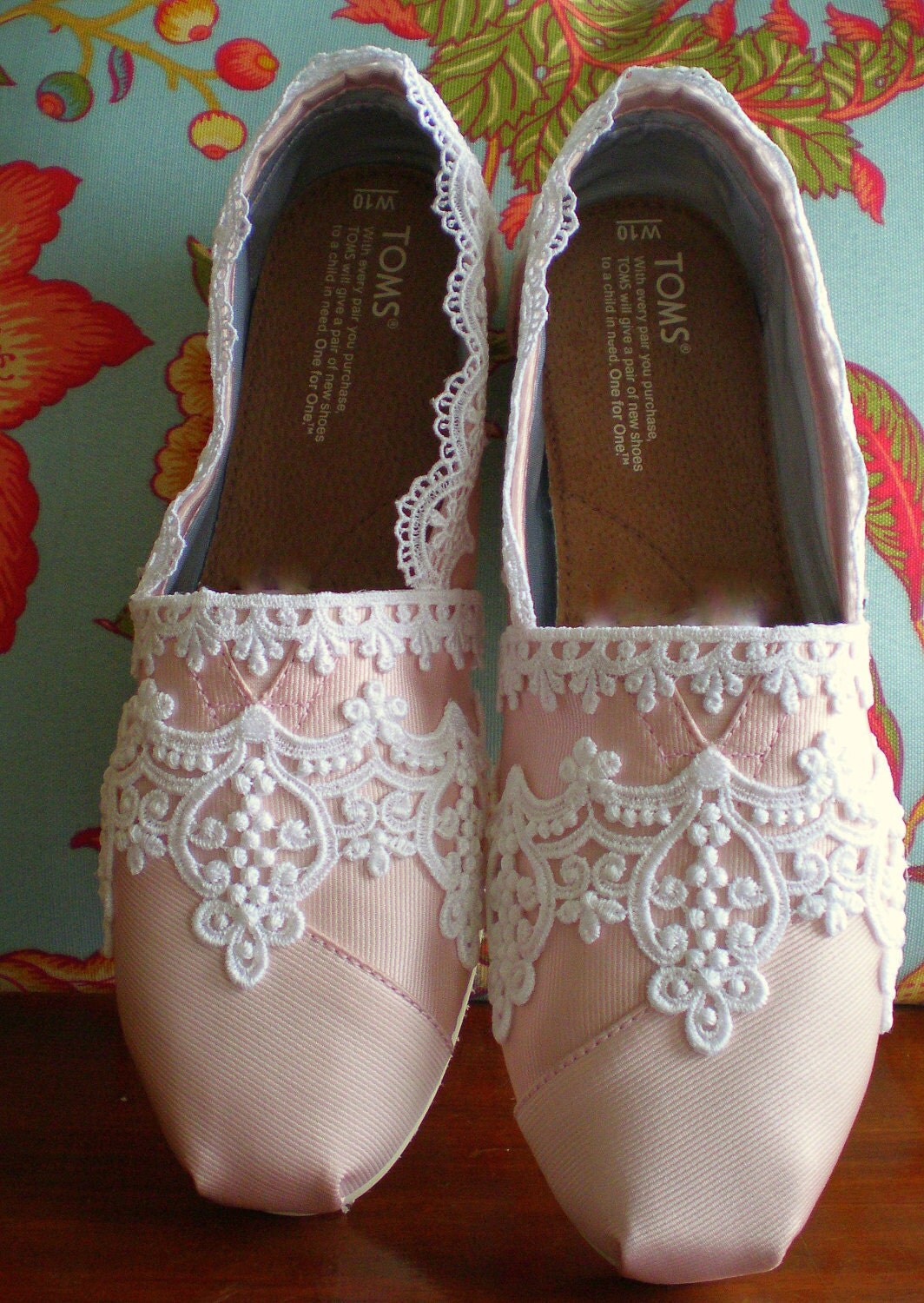
Revived after a fairly relaxing day (and a great dinner), we woke up early on our last day in Mendoza.  It was still pretty chilly, but not quite as windy as it had been the day before.  Since this would be our last opportunity to savor the free breakfast at the hotel, we took our time and enjoyed as much as possible.  Plus, it was still cold enough out to encourage us to stay within the warm confines of the hotel a bit longer.  We used the time to talk about--what else--girly stuff!  Well, as girly as either Mom or I can get, which amounted to more wedding ideas.  Now that we had the dress, we had to figure out accessories!  The most important accessory, of course, is shoes.  And if you haven't noticed (I may have even mentioned it a couple posts back), I sincerely despise shoes.  We purposely had the dress fitted so that I can wear no shoes if I want.  However, it is generally recommendable to wear something on your feet if you're going hiking, so I'll probably have to come up with something, at least to wear after the ceremony.  After buying the Toms-like shoes and talking to Jaimee (who has a slight obsession with Toms shoes) a couple days before, we thought that style would be a good option.  Mom is really crafty, so she offered to jazz up a pair for me.  We'll see what transpires between now and next summer, but as of breakfast, we'd settled on some shiny pink shoes with white lace.  That's bridal, right?  As bridal as you're going to get from me!

As you can see, I (and Mom) have kind of been taking over the wedding planning without giving much input to Scott.  I haven't really had much of an opportunity to talk to him since he went to England, because he still doesn't have internet at his house, and it costs 25¢ per minute to call his cell phone from Skype.  I'd already used up more than my monthly phone allowance calling him, so I was pretty much resigned to waiting another month until he finally gets internet at the end of October.  However, Mom was nice enough to top up my Skype credit so that I could call him a little more.  Her donation allows for 400 minutes, which seems like a lot, but spread out over a month runs dry pretty quickly!  We've still got 20 more days of non-internet, and we're already having to ration pretty strictly.  Anyways, the point is that I did get to talk to him from Mendoza, and it was awesome.  I told him about some of our ideas for the wedding (leaving out the specifics of the dress), and he said he'd be OK with anything I wanted to do as long as we were married in the end.  He did have one request, however, and that was regarding the cake.

www.brides.com
Scott's favorite season is autumn, and probably the only reason we're not getting married in the fall is because of the school schedule.  To go along with his appreciation of the season comes his admiration for the colors its produces, particularly orange.  We talked about mixing our two favorite colors--orange and purple--but the hue of my spontaneously-bought dress made this plan difficult.   Strange that purple and orange can be combined well, but pink and orange rarely work.  I'm not sure why this is, but I'm sure if I ask my design students they can enlighten me!  They were getting very frustrated when I made them do an exercise arranging sentences by the color I had shaded each word.  They were annoyed not because the exercise was difficult, but because I labeled the colors as "blue" instead of "cyan" and "pink" instead of "magenta."  So maybe we're mistaken and Scott's favorite color isn't orange, but perhaps auburn or even amber!  Either way, he is adamant about somehow incorporating this into the wedding, and is determined that the cake will be autumn-themed regardless of the actual season at the time of the wedding.  That's fine with me; I never really was into matching anyways.  My main concern is figuring out how to get a cake from The Little Aussie Bakery.  If you've never gotten the chance to try one of their cakes, you haven't truly eaten cake.

Anyways, after much coffee and wedding planning, Mom and I decided we were ready to tackle the day.  In all our days in Mendoza, we still hadn't gotten the opportunity to check out any of the museums.  There were a couple close to our hotel, but we were feeling adventurous and decided to try out one that the information officer had pointed out to me yesterday.  It was a bit of a hike, but it was built right on top on the center of the "old" city, so was sure to have a lot of history.  We had a map of the city, but after our experience trying to use a map to navigate the park, we were slightly hesitant to trust it.  Nonetheless, we headed off to the north, encouraged by the few rays of sunshine poking through the clouds.  Our plan was to head straight north until we came to the street on which the museum was located, then go east until we reached it.

We walked for quite a while, just enjoying the nice weather.  It was slightly chilly, but there was no wind and the bits of sunshine that broke through the clouds made it a perfect day for a walk.  We walked in silence, admiring the architecture and the slow pace of the people in the city.  We'd nearly reached the street where we were supposed to turn, but saw a big hill just a few blocks more to the north and decided it was worth the detour to investigate.  Turns out that was the corner of the Parque Central, a smaller but nonetheless impressive city park.  This park is also much newer--it was built in 2003.  We managed to walk the entire thing without getting lost once!  It helped that it was landscaped and heavily manicured, but we were proud of ourselves anyway.  We walked past a large mosaic and through the playground and stopped to watch a toddler chase the pigeons.  She actually managed to sneak up and grab one while he snacked on a piece of bread left on the ground!  I think she was more frightened by that development than he was!

We also stopped to admire some of the sculptures scattered throughout the park (while at the same time attempting to avert our eyes from the dozens of young lovers admiring one another).  Most of the artwork is what would generally be considered "modern art," and neither of us are big fans of that, so after a few minutes we decided to continue on our way to the history museum.  We passed under a highway bridge to get to the other side of the street, and came to the conclusion that we enjoyed the graffiti there much better than the official artwork in the park.  What can I say?  We have expensive taste.

After a brief detour down the wrong street, we were once again on track towards the museum.  As we approached our destination, the architecture began to change noticeably.  Not that the buildings downtown were skyscrapers, but they were fairly tall.  Out in the "old" city, it became mostly residential, and even the commercial buildings were smaller and less ostentatious. As I mentioned in a previous post, this is because this is the area that is considered the "original" Mendoza.  Before the earthquake, this area was filled with beautiful, traditional houses and was the commercial center for the city.  When the earthquake hit, everything was destroyed and the citizens could no longer bear to see the reminders of the former glory of their crippled city.  For many years, that section of town was completely ignored and became a place for homeless and vagabonds.  Eventually, the area became such a detriment to the town's safety that it was eventually rebuilt, but never to the same degree of elegance that it had originally.

Despite the citizen's reluctance to rebuild the area, they did a very nice job.  After walking quite a while through pretty boring streets, we came upon a beautiful plaza full of flowers and monuments.  If any of you are familiar with the layout of Spanish colonial cities, you may have been surprised to learn in previous entries that the main plaza of Mendoza is Plaza Independencia.  It is typical of Spanish colonial towns to be centered around a main plaza called "Plaza de Armas."  This is because the majority of these cities were founded to serve military purposes, so the main plaza was the place around which weapons (armas) were stored.  Usually the military leaders had the privilege of living the closest to this plaza, while those of lower social classes were forced to live further away.  Even today, when the military is not as prevalent (and if it is, tends not to be located right in the center of town), most colonial cities are still centered around their original "Plaza de Armas."  So, the plaza we came to here in Mendoza was the original Plaza de Armas that was destroyed with everything else in the city in the 1861 earthquake.  When the city was rebuilt, the main plaza was moved westward and given a different name.  Even to this day, there is no Plaza de Armas in Mendoza (although many tourists mistakenly give that name to Plaza Independencia, accustomed to the traditional layout of Spanish colonies).  The plaza we came to is now called Plaza Pedro de Castillo, after the founder of the city

www.constitucionweb.blogspot.com
At the far end of the original Plaza de Armas, next to Rio Mendoza (which actually turned out not to be a river at all, but instead an irrigation ditch dug by the Huarpes), stood the original cabildo (colonial government building).  It had been destroyed by the earthquake and nearly forgotten for many years.  In fact, a new fruit and vegetable fair was built on top of the former seat of government and life continued.  It wasn't until the late 1980s when archaeologists studying old maps realized the importance of the land underneath the fair.  They began to excavate and uncovered some of the original plaza.  Most importantly, they discovered a very well-preserved shell of the cabildo, protected over the years by the very thing that had been set up to forget it.  Excavations intensified to discover as much as possible about the history of their beloved city.  A foundation was even set up to preserve the discoveries.  Finally, in 1993, the Museo del Área Fundacional was erected directly on top of the old cabildo.

Now, before all my archaeologist friends get all nervous, don't worry.  Excavations are ongoing, so there is usually an archaeologist present to ensure the integrity of the site.  Of course, all objects were mapped and photographed in-situ before being removed for conservation and eventual exhibition at the museum.  The more fragile parts of the cabildo are visible only through a glass floor.  The other parts are visible but access is restricted.  While you can't actually go right into the cabildo, you can stand right above it and imagine its glory in years past.  The museum displays objects and information about the history of the area from Pre-Colombian times through to the present.  It's not a very large museum, but I was surprised at how in-depth the history was!  I've already given the basics of it in a previous post, so I won't go through it again.  The part that I enjoyed the most was the first-hand accounts given about many historic events throughout the history of Mendoza.  As I reach each story, I could almost imagine myself living the life of each individual throughout time.  In the end, I decided I was very glad to live in my own time period.

After perusing the museum for probably way too long (anyone who has ever been to one with me knows that I have to read every single panel about every single object), we were starting to get hungry.  It was quite a ways back to our hotel, but we figured we'd go part of the way and find a restaurant to have some dinner and restore our energy.  Mom took a quick smoke break before we started off, and I took the time to admire the statues in front of the museum.  I hadn't noticed before, but there was one story for each different era in the history of the city, and a quote underneath from a notable person from that era.  Of course, I had to take a picture of all of them.  If you want to see, check out the album on my Facebook page.  For now, you'll just have to be satisfied with  my favorite.  After admiring the artwork, we started off back towards downtown.  Of course, after a couple hours inside the museum while the weather was perfectly sunny, it started to rain as soon as we began walking.  Luckily, we made it fairly quickly to Avenida San Martin, a large street filled with shops.  Most of them had awnings, so we stuck close to the buildings, trying to stay as dry as possible.  Strangely, we weren't having much luck finding any place to eat, so we continued on.  At one point, the rain started to come down in a downpour, so we waited it out inside a discount store.  Full of imported and imitation goods, it reminded me of the dollar store.  Oh, home sweet home!

Luckily, the rain let up fairly quickly and were able to continue our search for sustenance.  We still didn't see many options, but kept telling ourselves it would be only on the next block.  About 10 "next blocks" later, we'd arrived back to Peatonal Sarmiento, the pedestrian street that we'd shopped on many times in the past few days.  Surely there would be something here!  There was actually a really delicious-looking restaurant right on the first corner, but when we got closer to investigate, it turned out they were closed.  At this point we were getting so desperate that we nearly just went to the McDonald's at the end of the block, but decided to give it one more try.  Good thing we did, too, because we came across a great restaurant!  Since this would be our last meal in Mendoza, we ordered one last bottle of wine and decided to try one more new type of meat.  We weren't quite as adventurous as day one, but we did order some grilled goat, just to round off our list of exotic meat.  I enjoyed it, although Mom wasn't a big fan.  It was heavily seasoned with rosemary, which reminds me of the food at The Little Aussie, so that may have been part of the reason I enjoyed it so much!  In the end we were glad we tried it, even if it didn't turn out to be our favorite.

www.englishrussia.com
After dinner, we went back to the hotel to pack up for our early departure the next day.  We still had to go pick up my dress, but were told it wouldn't be ready until after 8:00, so we used the time to organize our souvenirs and to just relax after the long day.  Finally, at about 7:45, we headed out to retrieve the dress.  When we got to the store, we were disappointed that Monica wasn't there (she was on business in Buenos Aires).  The saleswoman showed us the modifications that had been made, and took me into the dressing room to try it on one more time.  We had a bit of a scare when they couldn't get the zipper up, but rubbing it with a bar of soap fixed that.  Good motivation not to gain weight, I guess!  I modeled the dress one more time in front of the mirrors, and felt reassured that I still felt like a princess.  The seamstress pulled out a shawl and showed Mom how she could tie it behind me so that it wouldn't fall off.  She took some pictures so that she wouldn't forget in the 10 months before the wedding.  The saleswoman packed everything up into the garment bag and we were on our way.  We had a slight delay when we set off the alarm system and realized that they'd forgotten to remove the device from the skirt of the dress, but that problem was resolved quickly.

I felt a little strange walking through downtown carrying a huge dress above my head, but the awkwardness was overshadowed by my excitement to wear the dress.  Back at the hotel, we carefully packed it up in the suitcase we had bought especially for it.  We did some last-minute preparations, asked for a wake-up call, and headed to bed.  The trip back to Santiago the next day was much easier than the trip to Mendoza!  We were very glad for that; our trip sure had tired us out!

My New Friend

After so many warm days in Mendoza, we were surprised to wake up to a cold front the next morning.    We made sure to drink extra hot coffee during breakfast.  While we dined, we discussed options for the day.  Mom's back pain had flared up a bit, so we decided it would be best to take it easy.  Not even a bit of pain can keep a woman from shopping, however, so we got ready and headed back downtown to check out some more souvenirs.

The cooler weather must have scared most of the tourists off, because the shopping area was nearly deserted.  It could have also been the fact that we were awake a bit earlier than most people, too!  We picked out a few more souvenirs from the shops, and headed off in a different direction than yesterday to see if we could discover anything new.  We had been told that we might find some good leather shops in that direction.  Although we'd already gotten quite a few leather goods, there really is no such thing as too much leather.  Especially at the great prices they had in Mendoza!  Mom actually found a really neat leather bag that has three separate compartments meant to carry a thermos, mate, and hierba.  She's not really into hierba mate, but she bought it to use as a purse and to carry water (or Diet Coke) when she travels.  The salesperson also suggested that it would be a good place to hide wine.  Hopefully she'll refrain from doing that, especially in foreign countries!  I know we're all for new adventures, but I think jail is one that we'd all like to avoid, if possible.  

On the way over, we started talking about the dress and realized that we really didn't have any good way of getting it home.  Even though it's not a traditional wedding dress, it still is pretty big!  We'd only brought our carry-on suitcases, so there was no way we'd be able to fit it in one of those.  We discussed just bringing in on in the garment bag, but were worried about having to crumple it up in the overhead bins.  We decided the best way would be to invest in a new suitcase altogether.  Of course, as soon as we decided to start looking for one, they became almost impossible to find.  We ended up stopping back at the dress store to ask the salespeople there for a suggestion.  Unfortunately, all of them were completely different than the ones that had been there on the night we bought the dress, so were a bit confused at first (they thought we wanted to buy some luggage from them).  Once we'd explained that we'd already gotten a dress from their store, they pointed us in the direction of a luggage shop.

www.suitcases.me.uk
It was just on the next block over, and we'd actually passed it numerous times in the past few times without even noticing it!  We first tried to find a large rolling garment bag, but soon realized that it wouldn't be much bigger than our carry-ons and that it's singular purpose would make it inconvenient for future trips.  Instead, we asked for a large, hard-sided suitcase.  They had some really great Samsonite sets, but we decided to forgo those upon learning that they were more expensive than the dress itself!  We were about to give up and try another store when the salesperson pulled out a huge (very ugly) black suitcase.  It was probably large enough to fit a good-sized toddler inside, and then maybe even have room for his pet puppy!  It was the display model, but still had (some of) the protective plastic covering on it.  It looked like someone had gotten bored and started to pull bits and pieces off in places, which didn't help with the aesthetic appeal.  But it was sturdy, and it was on sale!  We decided to go for it, despite it's hideousness.  Maybe we can paint it pretty colors later.

I quickly took the suitcase back to the hotel while Mom relaxed in the plaza.  Even though it was only about 11:00 a.m., we felt pretty accomplished with our day.  We definitely deserved some coffee.  Of course, we couldn't return to any of the same coffee shops, we had to try something new!  We saw some tables outside on the other end of the block, and began heading in that direction.  On the way, we passed by an old, official-looking building with a beautiful stained-glass window at the entrance.  It turned out to the be the tourism office, so we decided to take a quick detour to see if there were any other things we simply couldn't miss in Mendoza.  The building was undergoing some remodeling, so the information was actually upstairs.  Mom's back wasn't behaving very well at this point, so she stayed down in the souvenir shop while I went up to get some information.  The guide showed me some points of interest on the map, most of which we had already seen in our wanders around town.  She circled a few museums that we should visit, but told me we'd have to wait until the next day because all the museums closed on Mondays.  When I caught back up with Mom, she'd already managed to have a conversation with the salesperson in the store and had bought some beautiful hand-blown glass jewelry for some of her friends.

Armed with more information and more souvenirs, we found our way to the coffee shop at the end of the block.  This one was probably the most "traditional" Argentinian coffee shop, in that most of was actually a bar where the customers stand to drink their coffee.  We were lucky enough to snag the last indoor table left.  The place was filled with people, mostly older men discussing politics and the lottery.  Seems like a strange combination of topics, but I guess they do both involve gambling.  We ordered our regular Diet Coke and cappuccino.  Mom was feeling a bit hungry, so she also ordered a "carlito."  Yes, in most Spanish-speaking countries, this would be the name of a little boy.  In Argentina, however, it is apparently a hot sandwich.  Hers came with ham and cheese.  I didn't get a taste, but I'm assured that it was delicious.  The waitress was a bit concerned that Mom didn't want any mayonnaise on it, though.

After our brunch, it seemed to have gotten even colder out than when we started.  This wasn't helping with Mom's back, so we decided to go back to our warm hotel and take a break for a while.  We'd ventured a bit farther than we thought, so it took us over half and hour to get back.  By the time we made it up to the room, I was beginning to get hungry.  Luckily, we still had our huge bottle of Diet Coke and some leftover bread and fruit.  I snacked on that while Mom relaxed with a nice game of "Angry Birds."  Well, maybe "relax" isn't really the best word.  Let's just say that Mom can get a bit competitive with her online gaming.  I learned quite a few new words as she played!  I am happy to report, however, that she is slowly but surely defeating those pesky pigs and has now reached level 6.  I really hope I never make her as angry as those birds do, though!

With Mom settled in for her anti-pig campaign, I decided to head out on my own a bit, lest I get caught in the crossfire.  I headed out in the opposite direction from which we normally went.  The woman at the information center had told me that there was a tower in the park that way, and that it had great views of the whole city.  I arrived to the park at 2:35 p.m.  The tower closes at precisely 2:30.  I was kind of disappointed about missing it so closely, but there were still plenty of other things to see in the park.   Spring has arrived in South America, so there were all sorts of fresh-blooming flowers everywhere!  There was a very large trellis covered with beautiful, purple flowers.  They smelled amazing!  They almost looked (and smelled) like lilacs, but not quite.  Either way, they are awesome and I want some.  Maybe someone out there can help me identify them.  There was also a huge tree filled with white blossoms.  They didn't smell as good to me, but the local bees thought otherwise.  I couldn't find a hive anywhere nearby, but the entire tree was surrounded by hundreds of bees!  I spent a while trying to get some pictures of the, but bees are quick little things!  It took me about 45 minutes, but I did finally get some good pictures.  In fact, the picture set as the cover to this blog was taken at that tree!

I wandered around a bit more, just enjoying the clean air.  It was nice to get out of the big city and be able to breathe for a while!  Eventually, I decided I'd better make sure Mom wasn't getting too violent with her pigs, so I started back towards the hotel.  On the way, I passed by the courthouse, where there was a protest going on.  I'm not familiar at all with Argentinian politics, but apparently there is a law that prevents mining companies and others from dumping contaminants into the drinking water supply.  Recently, there have been talking about repealing the law and allowing the companies to let their waste run off into the rivers--specifically the one that provides potable water to the city of Mendoza.  The protest was fairly small, maybe about 30 people in total, and quite peaceful.  In fact, most of them were just sitting on the steps, holding their signs and eating sandwiches.  I paused to take a look, and one of the young men came down the steps to explain their campaign to me.  Half of the explanation was made while he still had some of his sandwich in his mouth, so I didn't quite catch the specifics.  He said they were making a petition for the local government not to repeal the law.  He asked me to sign, and said it was ok for me to do so, even though I was a foreigner.  It sounded like a good cause to me, so I signed.  Hopefully I understood his explanation enough and didn't just sign up for a free year-long trip to Antarctica or something like that!

Now that I'd signed my life away, I figured I'd better definitely hurry back home.  I made a quick stop to snap a photo of some more flowers I saw on the other side of the courthouse.  As I was packing up my camera, a dog walked out from under the bushes and just sat down right in front of me.  I said "hello" to him, to which he responded by jumping right up on me and trying to "kiss" me.  I love animals and everything, but ever since my "flea" incident the last time I was in Chile, I've become very wary of strays.  He was very friendly and not in the least threatening, but I've learned the hard way that touching unknown animals doesn't always yield good results.  I pushed him down, said "good-bye" and continued on my way.  Apparently he wasn't quite ready for "good-bye" just yet.  He started to follow me, and I checked to see if maybe I had some leftover food somewhere on me that he was trying to get to, but I found nothing and I told him so.  He continued to follow me anyway.

I tried a few more times to get rid of him, but he just kept coming.  I've had dogs follow me for a block or two, but none ever this insistent!  The hotel was a good 20 minute walk away, so I figured that if I kept going, he'd eventually get bored and go back to his home.  Guess not.  He actually ended up following me all the way back to the hotel.  On the way, people kept asking me about him, assuming he was mine.  Even when I abruptly changed directions, he stayed right on me.  I eventually gave up and just gave in to the idea that I had a new pet for the day.  When we reached the hotel, he even tried to come inside with me!  The concierges weren't too keen on that, so they made sure to keep him out and even chased him a little.  Before I went in, I tried to tell the dog to wait outside for me, but as you all know my "dog-language" is a bit rusty so I couldn't be sure that he understood.  I wanted him to wait because we still had the leftovers from the parrillada in our hotel room, and I thought he definitely deserved a reward after walking so far with me.  I ran up to the room to grab the goodies, and hurried back out to try to find him.

I didn't see him anywhere on the sidewalks or in the streets of the next few blocks, so I figured the concierges must have scared him off.  I decided to walk back a bit in the direction we'd come from, to see if maybe he'd turned off onto another street.  I didn't have to go that far, though, because I found him in the little convenience store next to the hotel, trying to beg some chocolate from the owner.  Of course, the owner told me to get "my" dog out of his store.  I didn't even have to say anything, because as soon as the dog saw me, he ran right towards me.  There was a lot of meat left over, so I started out just giving him small pieces.  He wasn't too fond on the sausage, but he really liked the pork ribs.  He devoured the pieces so quickly that I finally just gave in and dumped out the whole bag for him.  I'm pretty sure he thought he'd gone to heaven at that point.  As he enjoyed his meat, I said "good-bye" one last time and headed back to the hotel.  I knew that if I stayed until he finished, he would try to follow me again and I was already doing all I could to fight the temptation to take him home with me!  By the time I came out again an hour later, he was gone.  At least I know he was well-fed!

Back in the hotel, I found Mom in the courtyard reading and enjoying some more Mendoza wine.  I asked her how her "Angry Birds" progress was, but she didn't want to talk about it.  Instead, we discussed the wedding a bit more.  I was concerned because I had initially planned to wear a simpler, shorter dress so that we could go straight from the ceremony to hiking in the mountains.  With the change of plans in the dress department, it looked like that wasn't going to happen after all.  And now that I had such a beautiful dress, I wanted an excuse to be able to wear it more, not less!  We talked about having a more traditional reception afterwards, but that's just not really my (or Scott's) style.  In the end, I decide I'm going to go hiking in the dress anyways--all we have to do is figure out some way to rig up the skirt so that I don't fall.  Although having a higher skirt doesn't necessarily guarantee that I won't fall anyways.

www.toursinspain.com
With that important decision made, I took a look at my watch and saw that if we hurried we could still make it to the open-top bus tour of the city.  Mom was still recovering from her back pain and her violent battle with the birds, but told me to go ahead without her.  The tour was scheduled to leave from Plaza Independencia in about 10 minutes, so I rushed out and hurried to the plaza.  I shouldn't have worried; Argentinian time is even less precise than Chilean time!  I got to the pick-up point just about two minutes before the scheduled departure, and the bus was only half full.  I figured it was because of the cold, dreary weather and hopped on to find a spot by myself near the back.  There were a few more people behind me, and once they got on, it looked like we were good to go!  Apparently not.  I guess the driver was determined to fill up his bus, even if it did mean some hard selling.  He left us in the parked bus and started to wander the plaza, trying to sell people on the idea of riding in the open-top vehicle up a large hill on a cold, windy day.   Most people weren't buying it.  Finally, he convinced a family of six to sign up and fill in the remainder of the empty seats.  Now, twenty minutes after the scheduled departure, we all settled in and got on our way.

As it turned out, the tour didn't show much of the city itself, but was instead focused on Parque San Martín.  The only part of the city that was included on the tour was the street leading from the plaza to the park.  I was kind of disappointed, because I'd thought that we'd already seen most of the park, but it was too late to get off now.  Oh, well, at least I would get the history this time.  Going up the main street to the park, I learned why we hadn't seen any very old buildings during our explorations of the city.  Mendoza was originally founded in 1561 by Spanish explorers who had come from Chile.  In fact, the city's official name is "Ciudad de Mendoza del Nuevo Valle de La Rioja," after the then-governor of Chile.  The town center was strategically placed on what the Spaniards believed to be the largest river in the area, but actually turned out to be a wide irrigation canal dug by the indigenous Huarpe people.  In fact, Mendoza is naturally a pretty harsh desert, but the native people had long ago conquered it with a complex series of irrigation ditches, some which are still in use today.

www.diasdehistoria.com.ar
With all the dirty work in preparing the land for habitation out of the way, the Spanish did what they did best: moved in and took over.  Actually, an interesting fact about this city is that it was one of few (or perhaps the only) that was acquired legally according to the standards of the native peoples in the area.  The explorer Pedro del Castillo had developed a good relationship with the Huarpe people, and had even spent an entire winter living among them.  This, along with the fact that the Huarpe were an exceptionally pacific people, led them to agree to allow the Spanish ownership of the land.  And besides, it really was in the middle of nowhere without easy access to water and other villages; how advantageous could it really be to them?  The Huarpes even helped to establish and build the new Spanish colony and were, in fact, its most populous residents throughout the rest of the 16th century.  Despite efforts by Chilean authorities to send colonists to the new land, it seemed most were reluctant to cross one of the largest mountain expanses only to reach a desert surrounded by "savages."  It wasn't until the early 17th century when a group of colonists were sent to the city and them promptly denied access back to Chile that the city started to grow.  Forced by the blockade to grow their own crops and become self-sufficient, the new settlers finally resigned themselves to life in Mendoza and adapted to their new environment.
www.juggle.com/mendoza
They adapted quite well (with the help of some farming techniques learned from the Huarpe), and by 1813, Mendoza was a thriving metropolis and served as an outpost for traders moving goods across the Andes Mountains.  It was this year that it also became the center for the newly establish province of Cuyo.  Things were looking good for the city of Mendoza, and it seemed as if nothing could slow its upward progress.
www.metaforaenadobe.blogspot.com
That is, until the night of Thursday, March 20, 1861, almost exactly 300 years after its founding.  As the clock approached midnight, the 12,000 residents were awakened as the earth began to move beneath them.  The area had been prone to tremors before, but nothing of this scale.  By the next morning, the 7.2 magnitude earthquake had killed nearly 5,000 people and left the survivors homeless.  Not one building had been untouched, or one life unaffected.  To date, the 1861 earthquake is still the largest ever recorded in the area.  For the residents of the city, that year became known as "el año que Mendoza desapareció."--"the year Mendoza disappeared."

But the Mendocinos are strong people, and the survivors dusted themselves off and began to rebuild the city almost immediately.  The "old" city near the river was left exactly as it had been by the earthquake.  Instead, new construction was begun to the west of the original city, closer to the mountains.  There had been a few houses in that area prior to the earthquake, and portions of them were still standing.  Architects designing the "new" Mendoza wanted to start over, so the post-earthquake structures were build in a very modern style, as opposed to the very traditional architecture of the original buildings.  In fact, the people held such reverence for their old city that it was over half a century before anything was rebuilt in the "old" section of the city.  In the newer parts, however, some interesting architecture sprung up.  Instead of completely demolishing the old houses, new structures were built right into them !  There are quite a few such houses that can be seen on the road leading to the park, but the bus was moving so quickly that I only managed to get a shot of one of them.  This building is now used as apartments, but the land was originally owned by a wealth Mendocino who built his estate there.  The entire building was destroyed in the earthquake, save for the magnificent turret that was incorporated into the apartments and now serves as a grand entrance for its residents.

By the time our quick history lesson was complete, we had arrived at the gates to Parque San Martín.  The park is part of the "new" city built after the earthquake.  In fact, it was built as part of a reforestation program that began in an effort to combat the epidemics of diphtheria, measles, and cholera that had plagued the city since the earthquake.  Originally named "Parque del Oeste" (Western Park), construction on this European-inspired garden began in 1896.  It was an ambitious project at a time when the city's resources were already spread much too thinly, and it was the cause of quite a bit of controversy among the city's leaders.  Some argued that the money would be better spent improving the sewers and waterways of the city.  Eventually, it was agreed that the park would do the most good in improving city health by enhancing the air quality in the area.  They also argued for the benefits of a "trickle-down" economy, contending that the beautification of the land would lead to higher property values encouraging a wealthier class of citizens to make their way to Mendoza, bringing their money with them. This money could then, in turn, be used to make other improvements that the city required.

I'm not sure if it was a direct result of the construction of the park, but Mendoza's economy sure seemed to be booming when we were there!  And I sure appreciate the efforts to construct the park--it's a great place to escape and relax.  It's also home to some of Mendoza's most famous landmarks, such as the Estadio Malvinas Argentina and the Universidad Nacional de Cuyo.  The university's medical school is located right in the heart of the park.  What a great place to study!  Another not so famous yet equally important landmark that can be found inside the park is the Club Mendoza de Regata--the city's rowing club.  We were lucky enough to catch a glimpse of the team out for their afternoon jog as we passed by the club.  Most of the people on the bus were middle-aged women, and I'm pretty sure the collective sigh that this sight released from them could be heard throughout the park.  It did, of course, catch the attention of the team, who were all kind enough to look over and wave at us.  I'm surprised none of the women fainted at this point.

As we all settled down from that excitement, the driver drove us to a roundabout with a huge fountain in the center.  This, he told us, was the "fuente de los continentes."  As stated before, the creators of the park were very inspired by European examples and wanted to emulate their idols as much as possible.  It'd be great to have a grand story about the origin of the fountain, but it was actually purchased from a catalog. Yes, that is correct--apparently such catalogs were fairly common at this time (was this the same era in which you could buy your house from a Sears catalog?).  It was purchased in 1910 from a French foundation for the equivalent of about $2000USD.  Despite its somewhat boring origins, it is a very beautiful work of art.  Modeled after 18th century European fountains, its four sides represent the four world continents--America, Asia, Europe, and Africa (at the time, Oceania was considered part of Asia and Antarctica wasn't really considered at all).  Each continent is held up by figures modeled after Greek statues, and at the base of the fountain mermaids can be seen frolicking in the water.  It's an interesting juxtaposition of many different cultures.  We drove around three times just to get a complete view!

Now it was time to head to the main attraction--Cerro La Gloria.  It is the biggest hill in the city (the Andes aren't in the city, so they don't count), but that's not what makes it so famous.  The hill is famous because it is home to the Monumento al Ejército de los Andes.  The "Ejército de los Andes" was the military unit from Mendoza that fought to restore independent governance to Chile and to free Peru from Spanish dominance.  Led by general José de San Martín, it was comprised mostly of freed mulatto slaves and former Chilean soldiers that had emigrated to Mendoza after the Chilean revolutionary war.  They are most famous for their successful crossing of the Andes, which took nearly a month.  Once across, they joined with other Chilean forces in Santiago and were instrumental in the defeat of royalist forces in various battles, including the Battles of Chacabuco and Cancha Rayada.  The Mendocinos are very proud of their contribution in these historic events, and this monument commemorates the brave men who fought so valiantly.

The monument was commissioned by law in 1888, but its creation did not begin until 1909.  It was designed and created by Uruguayan sculptor Juan Manuel Ferrari.  The work took many years to complete, but finally, in January of 1912, the final stone was laid on the statue on the anniversary of the army's departure across the Andes.  The monument was officially inaugurated on February 12, 1912, the 97th anniversary of the Battle of Chacabuco, and the day was declared a regional holiday.  Today, the monument is the most visited attraction in the city of Mendoza.  It's interesting to see the great detail in the monument, and I can easily understand why it took so many years to create.  In fact, I'm surprised it didn't take more!  I also learned (by eavesdropping on a different tour group) that there are  international rules regulating the creation of monuments.  According to the regulations, if a soldier is to be depicted on a horse in a monument, the horse must be positioned differently depending on how the solider died.  If the soldier died in battle, both of the horse's front legs must be reared up.  If he died as a result of wounds received in battle, one of the horse's legs must remain on the ground.  Finally, if he died of natural causes, all four of the horses legs must be firmly planted on the ground.  Not all sculptors follow these regulations, but Ferrari was a stickler for details.  His depiction of general José de San Martín shows the horse with all four legs on the ground.  After a successful career, the general retired to France, where he died of old age in 1850.

We stopped to enjoy the the monument and the view from the top of the hill for about 20 minutes.  Most of the people used the time as an opportunity to take a bathroom break and to grab snacks from the vendor at the other end of the parking lot.  Not many were too interested in the monument (which might explain why all the information I gathered came from reading the plaques and listening in on other tour groups instead of from our own guide).  I tried to get as much information as I could, because I know how much all of you love to read the extended history lessons on my blog!  I also took way too many pictures of all the detail on the monument.  I can't post them here, but check out my Facebook page to see all the pictures I took!  I also took a moment to enjoy the view of the city of Mendoza.  It's a lot bigger than I imagined, and it kind of reminds me of San Antonio.  The population is just under 2 million people, but even in the downtown area you always feel as if you're in a small town.  I guess that's just what you get from spread-out desert cities!

By the time we got back on the bus, the temperature had dropped and the wind had picked up.  As we headed down the hill at full speed, we all started to wish that the bus weren't open-topped.  We tried to enjoy the views on the way down, but I think most of us were just hoping to get to the tree cover as soon as possible and hopefully get out of the wind.  On the way down, we passed by the stadium, and everyone got really excited about that.  Most of the other people on the tour were Chilean, and apparently there had just been a big Chile v. Argentina match at that stadium, so of course this called for extensive heckling of our Argentinian guide.  He took it all in stride, though, and invited them to come back into town for the next match, when the tables would surely turn.  The rest of the way back to the plaza was fairly quiet, with the guide focusing on avoiding the rush hour traffic and the guests huddling together to keep warm.  I've never seen a group in such a hurry to get out of a vehicle, not even after the 10 hour flight from the U.S. to Chile!

After thanking the driver, I hurried back to the warmth of the hotel, where I once again found Mom cursing the birds for their inability to destroy the pigs.  By this time we were both pretty hungry, but neither really wanted to venture into the cold to find something to eat.  Instead, we opted for the hotel restaurant where we could avoid the wind and still get some great wine.  I opted for a salad, but Mom went for the stuffed chicken.  When we got our meal, we were disappointed that we'd left the camera in the room (but too hungry to make the effort to go back to get it).  My salad was very colorful, with fresh seared salmon.  Mom's dish looked almost too good to eat!  Her four large pieces of chicken were stuffed with a blend of ham and cheese, and were all arranged atop a saffron-spiced bed of rice.  To top it all off, there was a beautiful latticed potato slice sticking right out of the middle of it all.  We were pleasantly surprised to learn that not only was the presentation beautiful, the food was exquisite!  And reasonably priced, too!  We got our two meals and two glasses of wine for under $35!  All in all, it was a great way to end a long day.